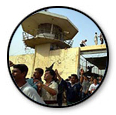
 Last April, The International Criminal Investigative Training Program [ICITAP] under the US Department of Justice [DOJ] assembled a team to travel to Iraq. Their mission was simple; to help "stand up" a fallen public safety system following the release of over 100,000 Iraqi prisoners and the shut down of all prisons, a collapsed police system and a virtually non-existent judiciary branch. ICITAP had completed the same missions in Haiti, Kosovo, Bosnia, Panama and the Soviet Union, rebuilding the police, the judiciary branch and corrections. However, this mission to Iraq was different. For the first time in ICITAP history, corrections professionals were invited to join the convoy.
"The DOJ has always had a police operations team that could go in and stand up the police forces in places like Haiti, Kosovo, Bosnia - but they had never before even thought about putting professional correctional experts on those teams. They would have police officers rebuilding a country's criminal justice system and trying to build prisons and jails along with their traditional police expertise," says Lane McCotter, a member of the initial ICITAP corrections team that deployed to Iraq last May.
On May 4, 2003, the first ICITAP corrections contingency in history landed at Fort Bliss in El Paso Texas for a 6-day training program including nuclear, chemical and biological preparedness, medical shots and physical evaluations. The team leader, William "Bill" Irvine was from Great Britain. Gord Holloway was sent by the Correctional Services of Canada to evaluate the state of corrections in Iraq. Plus, four US team members were invited by the US DOJ:
 Lane McCotter is a retired colonel in the United States Army and military police officer with 24 years in the military including a double tour of Vietnam. He has over 37 years in corrections and law enforcement including as the warden of the U.S. military prison at Ft. Leavenworth, Kan. He is also the former Director of the Utah Department for Corrections, former cabinet secretary for the New Mexico Corrections Department and former Executive Director for the Texas Department of Corrections. He has a bachelor's degree in Engineering and a masters degree in Criminology. He is a graduate of the Army Command and General Staff College. McCotter is currently the Director of Business Development for Management and Training Corporation [MTC].
 Terry Stewart was the director of the Arizona Department of Corrections. He is a former chief of police. He has a bachelor's degree in Business Administration, a master's degree in Business Administration and has completed his course work towards a Ph.D. in Public Administration. Stewart joined the team as a prison consultant from Science Applications International Corporation [SCIC], the company that had won the government contract to assess corrections in Iraq.
 Gary DeLand is Executive Director of the Utah Sheriff's Association and a criminal justice consultant and trainer with expertise in policy development, jail/prison standards, legal issues, staff training and architectural projects for new jails and prisons. He began his corrections career in the 1960's and was the Salt Lake County Jail administrator from 1972 - 1979. He received a B.S. in Physical Education (with Corrective Therapy certificate), a B.A. in Sociology (with Criminology emphasis) and in 1985 earned his Master of Public Administration. DeLand was originally scheduled for the initial deployment in May, but would not join the group until 6 weeks later after a misfiled/misplaced passport application held him stateside.
 Larry DuBois, served as warden and associate warden for several federal institutions and as the Regional Director for the Federal Bureau of Prisons and Commissioner of the Massachusetts Department of Corrections. He has a bachelor's degree in Sociology and was a fellow at the Harvard University School of Law. DuBois was the original point man contacted by the DOJ to secure resumes from qualified correctional experts who would later be screened and chosen to join the ICITAP corrections contingency.
Together these men brought over a century of correctional expertise and leadership. It was clear from the start that these men had the right stuff to begin rebuilding corrections in Iraq. The Corrections Connection Network News recently caught up with Lane McCotter, Terry Stewart, Gary DeLand and Larry DuBois and asked them to recount their mission in Iraq.
This is their story and they tell it best.
Terry Stewart: What really grabbed me was that ICITAP has done this in many places, but they had never included a corrections component before - this was the first time they had ever deployed an operation with corrections - and I wanted to be a part of it.
Larry DuBois: Sharon [my wife] said the reason I wanted to go is that I missed Vietnam. I was paratrooper but I got out just before Vietnam started and this felt like it was my time to go over and do something for my country. I did not know that part of the world so I did not know what to expect. Of course, the briefing we had in DC gave us some idea - but not what we faced there.
Lane McCotter: When I got the call to go to Iraq I told my wife "well I am too old so I will probably tell them no." My wife said "I am not going to live with you walking around the house wishing you had gone to Iraq." She could see on my face I wanted to go. She is a very supportive, very patriotic military wife and she wanted me to go. I did 2 tours in Vietnam so on the plane ride over this was like coming home for me.
On May 12, McCotter, Stewart and DuBois land in Kuwait City.
McCotter: The plan was to drive from Kuwait City to the Iraqi border, Baghdad City. It was supposed to be a 6-hour convoy led by Iraqi Curds.
Stewart: There were about 30 ICITAP members in all including police officials, federal and state judges, attorneys, and corrections. They issued 26 cars and Lane, Larry and myself each drove our own vehicles. Together we moved without a military escort and without any weapons.
McCotter: Then we got lost and ended up driving 16 hours on 2 hours sleep.
DuBois: The real challenge was driving over 16 hours through a sand storm that had started at 9 p.m. the night before. You could only see 2 to 3 cars in front of you.
McCotter: By the time we got into Baghdad City around 9 p.m., it was way after curfew, we were out of gas and nobody knew the city. We spent an hour out in the dark hearing shots and blasts going off, driving by [fresh] bodies laying on the road, not knowing where we were going and having absolutely no weapons. The first night in Iraq was rattling and it was an interesting start to our whole mission.
Stewart: Finally, we were placed in 2 separate hotels. We needed them both just to accommodate all of us.
DuBois: I was about 5 blocks from Lane and Terry's Hotel. The next morning at breakfast we would talk about what time we were awakened by the Iraqis' shooting.
It is now morning, May 16th and McCotter, Stewart and DuBois assemble for their mission briefing.
Stewart: We met our international representatives. Bill Irvine from Great Britain was the leader of the corrections component. There was a forensic accountant Kenneth Grant, who was assigned to us from Great Britain to manage the money. We were also joined by a gentleman from Canada, Gord Holloway. The police contingency was headed up by an American, Bernie Kerrick. Kerrick was the famous former NYC Police Commissioner and was brought over by President Bush to serve as the senior advisor to the ministry of Interior. As far as a leader for the judges I am not sure who was in charge.
Stewart: That day, the corrections group assembled for our mission briefing.
DuBois: We were originally there under General Garner of Office of Reconstruction and Humanitarian Assistance [OHRA] in Iraq.
McCotter: Our team was supposed take 3 months and do an assessment of the entire criminal justice system, document, write a plan as to how we would stand up the criminal justice system after the war. That is what we thought.
DuBois: Then they gave us a new moniker ---- The Coalition Provisional Authority [CPA].
Stewart: Presidential Ambassador Envoy L. Paul Bremer, had just been placed in charge as the civil administrator [acting President] for the newly formed CPA and because there were no corrections or detention facilities operating, Bremer said we can't afford to have you do an assessment and then start activating prisons.
McCotter: So after the first 24 hours in Baghdad, Bremer said, we want you to do an assessment but we want you to do it in 30 days and at the same time, we want you to get the first prison in operation within those first 30 days [by June 15th].
Stewart: This presented a real challenge. Suddenly, we needed to go out and quickly assess the facilities that could be activated and then go ahead and activate them.
The next day, May 17th, the now 'corrections operations team' prepares to assess and rebuild prisons. There was just one problem.
McCotter: First thing we had to do was find them [the prisons].
Stewart: In Iraq there were prisons operated by 4 different groups - The Ministry of Interior ran the detention centers, The Ministry of Labor and Social Affairs ran the prisons, there were also the Secret Police Prisons and the Military Prisons.
McCotter: In fact, [it was so confusing] even the CPA had no idea who we should work for in Iraq so we kind of got passed around for a few weeks. Finally, the corrections department was later placed under Ministry of Justice.
Stewart: The good news was that when we arrived [in Baghdad], the military had already identified 151 prisons throughout Iraq under all 4 groups. Of course even after I left they were still finding and identifying prisons. But when we arrived none were operational.
McCotter: Unless you count one facility in Mosul [The OBSERVATION HOUSE], where the military was holding some detainees. You have to remember that on October 20, 2002, Saddam emptied all of the prisons; more than 100,000 prisoners were set free and armed and the rest were executed.
Stewart: What we didn't realize was that Saddam had also ordered that all inmate and staff records be destroyed. So virtually in every prison we went into there was a room, where they had taken records and burned them. They had been emptied long before coalition forces began the invasion.
DuBois: So we didn't know the inmate population. Not having records, meant we didn't know which ones were political prisoners and which ones were tried in courts. We had nothing to start from.
The team knew the clock was ticking and they had to start with what they had. Of the 151 prisons found by the military, the team made a list of 21 of the largest facilities. They determined this was the best way to reach their goal of activating 14,000 beds by Dec 31st.
DuBois: As a team the four of us [McCotter, Stewart, DuBois, Halloway] went out and looked at several institutions around Baghdad. We wanted to get an initial assessment together.
Stewart: We wanted to make sure that we were all assessing the facilities in the same way so we looked began the assessment as a team.
McCotter: We had to quickly come up with which ones [prisons] we could recondition and put back on line. We had to get a complete assessment of damage, find Iraqi construction companies to repair them, determine how long that was going to take. And we had to do it in 30 days.
It was almost like you have been preparing for something like this your whole life - to bring together everything you have ever learned and to put an entire system together and watch it come to life from absolute utter chaos and destruction and operate the way you know it should or could. It was such a fascinating and personally rewarding experience for all of us.
The first facilities the team looked at were AL TASFERAT and AL RUSSAFA located near each other in Baghdad. Also Al-HAKEMIA in Baghdad and AL HILLAH located 60 k south of Baghdad. As they entered those first facilities, the team was not prepared for what they found.
DuBois: If you could imagine going into your house and finding no plumbing, electrical wires ripped from the walls, just walls standing - that is the way it was. I was amazed at the amount of destruction the looters had caused.
Stewart: The copper wire, electric motors for air conditioning, window frames and door frames had all been looted. In some cases there were no walls.
DuBois: Plus in Baghdad the electricity was so intermittent and you can't run a prison without electricity so we were starting to think about generators just to keep the facilities running.
I had opened a new federal institution when I was in the Federal Bureau of Prisons so I knew about all the little things you had to do - such as food service, receiving and discharge. Then when I got to Boston I found out we had 22 institutions and they ran differently so my goal was to getting them all singing from the same handbook. So that [the disorganization] did not shock me as badly as having absolutely no infrastructure at all.
After those first prisons, we knew this was going to be a time consuming process.
After the initial assessment, the corrections team knows they must pick up the pace. They decide to move out in different directions to achieve wider coverage faster.
Stewart: We decided to split our team up into 2 teams - a Baghdad team and North/South Team.
DuBois: Before we leave, the four of us meet to agree on standards we will apply during the assessment. This included the allowable square footage per bed. We went back and forth and argued as people do but in the end we said "what is fair?" and we came up with 50 square foot for 2 bunk beds. The standards were dictated by the atrocious conditions that the original facilities were in themselves.
Stewart: At TASFERAT and RUSSAFA there were no bunk beds. It was literally standing room only. The prisoners were stuffed in like cords of wood and they couldn't even lay down and go to sleep because there were so many people crammed in there. In the summer when it got hot, they would allow each inmate an ice cooler. If you think about it, the cooler, which was set on the floor had to take up a previous inmate's space, so somehow the capacity [of inmates] was going down in the summer [perhaps execution or death from the conditions].
DuBois: The day Saddam released the inmates from AL HILLAH - they had 3,000 inmates with 14 toilets and 10 showers. We estimated that should hold 750 beds. You would walk into a dorm that was basically an open room and there would still be a row of blankets spread out over the floor right next to each other. And as we would wander around AL HILLAH, the Iraqi's would show us where prisoners were tortured or hung. This is where we found one of the largest mass graves.
We realized that's what the inmates were used to and if we were going to get anything up and running initially, we had to make our standards humane but also realistic.
With their standards aligned, Gord and Larry go North and South. Lane, Bill Irvine, Kenneth, Terry and myself keep working in Baghdad.
DuBois [recounting his time in Mosul]: Gord and I went north to Mosul for 3 days. We drove up there as a caravan with 6 policeman and Iraqi guard civilians armed with AK-47s. We saw 3 separate prisons: one was a juvenile facility called THE OBSERVATION HOUSE. It was already running by the US military. It had no juveniles. Instead it was holding looters and those arrested awaiting trial.
The second prison was called BADUSH. Here the walls were 1 mile long and had 3 separate facilities inside - but absolutely nothing was left except for the walls and the ceiling. It had been totally looted where even the wires and windows were pulled. The grills had even been taken and sold for money. The toilets looked liked Turkish toilets with just a hole in the floor with a ceramic thing you use for #1 and #2.
The third prison was a jail known as the TRANSPORTATION CENTER. It had been taken over by a group of individuals claiming it as a mosque. It was right next to the police station, so we went into see the chief of police and he told us he could get us in. But it was their religious holiday and we decided discretion was the better part of valor. So we never got in to see it.
Mosel was a quieter town. Everyone there including the Mayor had all but given up or left and for the first time since I flew into Kuwait, I felt comfortable. There, we met with engineers and asked them to come up with some figures as to how much it would cost to get at least 1 of the institutions up and running at BADUSH.
They came back with a figure of about 3 million dollars.
Larry and Gord now catch a C-130 transport plane and fly to Basra run by the British troops. Basra is not as quiet as Mosul.
DuBois: As soon as we arrived, we were escorted by the Military police to a local hotel. The MP's dropped us off and left. There was no security and all night we could hear shootings.
There we met with the commander of the British troops and he briefed us. They were getting ready to open a facility [about 100 beds] in Baghdad [AL-SAHLYA]. We made our recommendations for security and operations.
We also looked at AL-MAQUAL. This facility would accommodate 300 beds by the standards we [the corrections team] had determined. Once we determined AL-MAQUAL could be refurbished for 300 beds, we contacted engineers to get estimates for rebuilding. There were squatters there too so we didn't get to see the whole thing. But from what we saw it could have been up and running in about 9 months to 1 year.
Next, we visited the OLD BASRA JAIL and it probably should have been condemned years ago even before the looters got to it. It was downtown Basra and it had a death chamber. Open sewage flowed down the middle of the jail even when it was operational. It was pretty deplorable. Gord and I went in with a military officer and a sergeant and we actually surprised some people who were going to loot the place. We convinced them that we weren't going to arrest them and they starting talking to us. They were former inmates there and they showed us were inmates were tortured. They showed us the open trenches were the sewage flowed and they told us of how Saddam would cut off the ears of inmates who would not fight for his regime. This jail would have to be cleaned up before it could be used as a dump in the US. It was that bad.
By this time, Gord and I are thinking that if we can't find anything better than what we have seen - then we are in trouble.
Meanwhile, back in Baghdad, funding is underway for the first detention facility -- AL SAHLYA.
Stewart: The First priority was opening a detention center and so it opened in a few weeks of our arrival.
McCotter: We helped open Al-SAHLYA right away. It was an adult male facility with 100 beds. It was already housing detainees under the military who had made renovations before we arrived, but it needed more funding and a place to house female offenders. We got the funding and made our recommendations [for training, security and operations] to the military.
Stewart: Most of the work and the funding that caused those things to happen was the result of the Military Police that were there. They gave us exceptional support especially the 18th military police brigade who already had a pipeline in place for requesting funds.
The Baghdad duo [Stewart and McCotter] continues assessing 4 more facilities in Baghdad including the largest and most feared prison in Iraq.
Stewart: We traveled to Abu GHAIRB. This was an infamous prison in Iraq because that is where they did many of the executions. In fact the CPA, at the request of the Iraqi people took the execution chamber and made a memorial out of it.
McCotter: Saddam had executed over 30,000 people over 35 years and those are just the ones that can be accounted for.
Stewart: It was a monstrous prison built in 1960 by the Germans. It had 1-mile square walls with 4 compounds inside.
McCotter: Of the 4 major prison compounds - 2 were destroyed and 2 were 80-90% destroyed. But that is the only place that we agreed as a team was truly closest to an American prison. They had cell housing and segregation.
Stewart: It even still had Folger Adam hardware in it and when we called Folger Adam, they said yes "we still have the key codes to all those locks."
McCotter: By American Correctional Association [ACA] standards the one compound we were discussing renovating would hold 3100 inmates and Saddam was putting 6,000 to 7,000 prisoners inside. They don't use bunks - most cells were so packed they could not even sit down.
Stewart and McCotter also visit AL-KADMIYA Prison, Al-KARKH Detention and a new prison Saddam had built called KANBAN'I SAAD that was rumored to hold nearly 3000 prisoners. On May 24th, they take a trip to KANBAN'I.
Stewart: We heard KANBAN'I SAAD could hold 2880 of the 14,000 beds we needed. But when we got there, we found Marsh Arabs. Years ago, Saddam decided that he was going to make the marshes in south central Iraq tillable land so he drained them. When he drained the marshes he displaced the Arabs that lived there [Marsh Arabs]. So he went north, kicked the Curds out of their property and sold it to the Marsh Arabs. When Saddam's regime toppled, the Curds descended on the Marsh Arabs and drove them out. They wandered and got to the northern outskirts - there Saddam was building KANBAN'I. It had been looted but it provided shelter so the Marsh Arabs moved in along with their goats, their water buffalo and their dogs.
We immediately wrote Bremer to help place these Marsh Arabs so we could take possession of the prison. This took several months. Before we could get the plan approved, just 3 weeks after our original visit, the prison had been virtually disassembled by the Marsh Arabs - everything was stripped out of the walls. So our 14,000 bed count was reduced to 11,000. That is why our original plan only included about 11,000 to be reactivated by Dec. 31.
There is no time to morn the loss of KANBAN'I. McCotter and Stewart must open AL TASFERAT, a 400-bed capacity detention center that the entire team had assessed in the first week. TASFERAT was chosen as THE facility to open by June 15th because it's centrally located in Baghdad, close to the national police academy and one of the largest police stations and it appears to be structurally sound. Plus previous staff can be located and returned to work.
McCotter: Terry was in charge of opening AL TASFERAT.
Stewart: TASFERAT was also known as the Transportation Center where all inmates awaiting trial or being sentenced originally waited to be transported to the various prisons throughout Iraq. It was in pretty good shape.
The challenge was that CPA wanted us to use Iraqi contractors [to refurbish it], but it was not easy getting the materials to the Iraqi contractors because after 30 years of the regime there were no jobbers or warehouses to order supplies. At first we couldn't get the right materials even for beds so we used what we could. Eventually sheet metal became available so we built bed frames.
McCotter: It was an amazing thing - everything you have ever learned in your life came into play - you didn't have a staff - you were it - you had to plan the reconstruction, get the funding for it, hire the crews, draw the money [there were no banks to put it in], oversee the crews during construction - you literally had to tell them everything you wanted them to do. I remember that they had never used bunks before so we had to find a contractor and draw him a picture of what we wanted and them ask him to make it. Then find someone to make mattresses. Everything you can image, that we can take for granted.
Stewart: For soap, shampoo and sanitary supplies for the woman, even mops and shovels, we literally had to 'go shopping' at the large stores in Baghdad, which were still smaller than our grocery stores in the states.
McCotter: You couldn't find handcuffs or belly cuffs. We had to find a place to order-in the handcuffs. All the little details - we had to hire contractors to bring in food. We hired local vendors and supervised them. You couldn't skip any detail or else you would come up short by the end of the day. It was really an interesting thing that none of us had ever been through before.
Stewart: It was unbelievable. And there were no checks. You had to deal in cash. Then, in many cases, you had convert the US money in Iraqi Dinars and the exchange rate ranged from 1,400 to 1,800 dinars for $1. So if you changed 100 dollars, you had to have a bag to carry it in.
McCotter: We hired Iraqis to run this prison. We had identified those Iraqis who had run this prison before.
Stewart: They were easy to locate. There was about 100 staff just hanging around on Payday.
McCotter: But those prisons were so corrupt before the fall of Saddam we knew we had to give them additional training. Terry worked hard to put together a 3-day training program taught through an interpreter. The 72- hour course talked about human rights and anticorruption.
Stewart: I gave them an 8-hour course on human rights and anti-corruption and the daily regiment of prisons. It was interesting teaching through an interpreter. And when I said "you can't physically hit an inmate," I thought the staff would riot. They said. "how can we control them?"
While Stewart gets TASFERAT ready, Lane juggles several other projects and they both work nights to write the report.
McCotter: I was in charge of getting the funding for 5 additional facilities we assessed in Baghdad: AL-KADMIYA [400 beds], Al-KARKH [350 beds], Abu GHAIRB [400 beds] Al-RUSSAFA [416 beds], and Al-HAKEMIA [300 beds].
Stewart: Most of the money we spent while we were there came from the seizure of the Iraqi assets. The CPA had already developed the funding approval mechanisms. It was nice to have the MP there ready with the resources to help us do what we needed to do.
McCotter: At the same time I was seeking funding, I was also looking for a location for the Iraqi Correctional Services headquarters.
In addition, each night, the two of us [Stewart and McCotter] would stay up until midnight or 2 a.m. writing our report that was due on June15th.
A lot has happened in 10 days since the 2 teams separated and they are now reunited in Baghdad. AL-SAHLYA is opened. TASFERAT is slated to open next week, Stewart and McCotter have written 95% of the report, Stewart has written and administered the first staff training program and DuBois and Holloway have completed the North and South evaluation and are filling in the gaps for the report and helping with TASFERAT. The team is in hustle mode.
DuBois: When we came back to Baghdad, we initially all worked on TASFARET and helped with the paper. The next week --- I was assigned to work on AL HILLAH. Terry continued with TASFERAT.
McCotter: At this point, I am still in charge of funding and now seeking money for the OBSERVATION HOUSE [already in operation in Mosul], BADUSH [2000 beds in Mosul] and Al-MAQUAL in Basra [350 beds].
The next week, on June 15th - TASFERAT opens and McCotter and Stewart submit the 60-page plan entitled "An Assessment and Recommendations for Prisons in a Free Society" to Ambassador Bremer. The Assessment Plan classified 15 of the 21 facilities into 4 groups - immediate (currently operational), short term (opened by July 1st), intermediate term (open by September 30) and long term (opened by Dec 31st). [click here to view a summary of facilities assessed under the plan]
McCotter: We [TASFERAT] were basically opened by the 15th of June. We had done the 3-day training that Terry wrote and we were ready to move in. The military was already there to start trying to take over that operation.
Stewart: When we submitted the plan, we determined that in reactivating TASFARET and the remaining prisons they would need an estimated 30 million dollars for the first 6 months. That included refitting the building and reconstruction, furnishing everything, then providing all operational costs like the food for the period of time it would operate through the end of the year. Again, the majority of that money came from seized Iraqi assets.
In 30 days, the first-of-its-kind International corrections contingency had achieved the seemingly impossible. They have assessed 21 facilities, help open a detention facility [AL-SAHLYA], single-handedly opened the first prison [TASFERAT] and completed their written assessment. Still there is no time to enjoy the triumph. They have opened less than 1000 beds. DuBois is now put in charge of opening AL HILLAH. The mission continues.
DuBois: My Goal in AL HILLAH was to get the institution so it was at least presentable to inmates, staff and community. I was fortunate because I had the old head of the institution and he had maintained almost all of his staff throughout the war. In addition, while other facilities like ABU GHRAIUB were considered corrupt, AL HILLAH was known as a fairly decent place to do time and there was a lot less corruption. They also had not looted all the beds and plumbing. I even had some grills.
Plus I had a Sergeant, Private first class [PFC] and 1 interpreter assigned to me. Then when I put in my request for $150,000, it was approved in 4 days. AL HILLAH even had a bank. Basically you walked in and there were GI's and M-16's guarding the place. I was the first non-Iraqi person to be able to deposit US currency into this bank. They handled Iraqi money and our money that they put in a safety deposit box. They actually gave me the same exact dollars I handed over to them so they were literally just guarding it.
I needed the money for a new electrical system, emergency generator, new kitchen, renovating the dorms and segregation cells. We were going to contract out food service - have a local person deliver the meals, then contract out healthcare - dental, medical, psychological. I had a local contractor that was doing everything from putting in new lights, new ceiling fans, exhaust fans for the kitchen, painting the institution inside and out, window glass repair, re-welding and repainting bunk beds. And all the work was getting done for $150,000.
We put up florescent lights at $6/light. I had the institution painted (inside and out) for $7,500. The contractor charged $1,000 to clean and remove the rubble. Nobody had any money, and the Iraqi money was funny money because they had broken into so many banks and stolen it. There were no coins because of the looting so they disallowed them as worthless. I think the hundred and the ten-thousand dinar was the only monetary denomination left. I paid my interpreter, who was also an engineer trained in Italy at the university, $20/day.
I don't know what the contractor was hiring the people for, but between visits, I would see such a dramatic change in the condition of the facility. He had 20-30 people working throughout the institutions. 1 would be sleeping, 1 would be painting, 1 hanging fixtures. He was probably paying these people 50 cents to 1 dollar a day. They were hard workers.
I could not have rebuilt an institution in America that had been gutted for $150,000. That would have cost $4 to $5 million in the United States.
It's the end of June and Gary DeLand arrives in Baghdad, 6 weeks after the initial team deployed. He assumes he will be joining his team in a 3-month assessment effort. Instead, in his first week, he is thrust into learning the Iraqi culture while he is transitioning to become the new point man for TASFERAT and AL-HILLAH. Stewart and DuBois have made plans to return home in less than 7 days. Thing are just about to get more interesting.
To be continued next week...
NEXT WEEK.....3 more facilities are in the works to open in the next 60 days. During that time, McCotter and DeLand face a new set of challenges including a corrupt staff where 70-80% of those rehired and trained must be fired, and a corrupt director removed at gunpoint. They also make new inroads creating a personnel department and a full blown training academy and finding the headquarters for the new Iraqi Correctional Services. Plus, the team makes their final conclusions and suggestions for the future.



Comments:
No comments have been posted for this article.
Login to let us know what you think