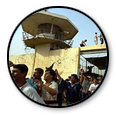
 This article is the second in a two-part series describing the role of American correctional leaders in the rebuilding of the corrections infrastructure in Iraq.
* Part One Feature
* Part One Photo Profile
* Part Two Photo Profile
It has been 45 days since the first correctional assessment team was invited to Iraq as part of the International Criminal Investigative Training Assistance Program [ICITAP] under the U.S. Department of Justice. The ICITAP mission was to help "stand up" a fallen public safety system and police, attorneys, federal judges and correctional experts from the U.S., Great Britain and Canada were quickly deployed. The correctional team had been asked to provide a three-month assessment of the Iraqi correctional system. When they arrived in Baghdad, U.S. Ambassador Paul Bremer took over as the civil administrator for the Coalition Provisional Authority [CPA] and the plan changed. Then, the team had 30 days to assess and open the first correctional facility.
The story is told by the members of the U.S. correctional team of Lane McCotter, Terry Stewart, Gary DeLand and Larry DuBois.
It is now the third week in June and the team has assessed 21 facilities, submitted a 60-page report to Ambassador Bremer [view summary of facilities assessed], opened the first prison called AL TASFERAT and a detention facility called AL-SALHYA, has started refurbishing ABU
GHRAIB and AL HILLAH and has requested funding for four additional facilities.
Gary DeLand, the fourth member of the U.S. team arrives in Baghdad six weeks after the initial ICITAP corrections team is deployed. He is about to discover what his correctional counterparts already know: the group has become an "operations" team rather than an "assessment" team and Stewart and DeBois have made plans to return home in less than seven days. Within 24 hours DeLand is thrust into the Iraqi culture while simultaneously transitioning to become the new point man for AL-TASFERAT and AL-HILLAH.
McCotter: When Gary first arrived, Terry and Larry knew they were leaving and so Gary had to get up to speed fast on what they were doing. Gary spent his first week shadowing Terry at AL TASFERAT and AL HILLAH so he could take over. In the meantime, I was involved in refurbishing ABU GHRAIB.
Gary Deland: I was supposed to be deployed in May with the rest of the team. By the time I got there, [after passport difficulties] I found that the team had three-four weeks to assess instead of three months and that they had already opened one facility [TASFARAT].
Here I am, I don't speak the language and I can't get into a car and drive some place. Plus, now that facilities are up and running, I can't call them [by phone] because most were in dead zones. You had to be in Baghdad to make a call. I couldn't even call the director of the prisons. You had to get a hold of the military units close by and tell them. Or drive or fly there. You could normally get a lot done with six people - but not if those six people all
have to jump in two cars with guns and go to the same place. I loved every minute of the job. I enjoyed that assignment more than any other job I had in my life. But there was that immediate frustration. How could Terry get his work done if he had to go with me to get my work done and so on? As more facilities opened up that became even tougher.
You cannot imagine what it is like being someone who is used to walking into a place and making recommendation right away [and then having this situation]. It took me three weeks to a month to really be productive there.
Plus, I didn't know anything about Baghdad or staying alive in Iraq, which is an important part of the job. Terry Stewart taught me how to drive and stay alive. You basically drive like there are no laws and no police. When I asked "What are the rules?" I was told ---- #1 the gutsier one has the right away; #2 you never stop if you get into an accident. If your vehicle is incapacitated, you jump into other vehicle; #3 you don't stop at intersections because you don't want to be a lingering target. So you move even if there is traffic and that means driving on the sidewalk if you have to.
I just reverted back to when I was 16.
It is now the first week in July. Stewart and DuBois along with their British and Canadian counterparts have returned home. The correctional team now consists of McCotter and DeLand.
With the assessment phase behind them and much of the renovations under control, McCotter and DeLand can now focus their efforts on operations at TASFERAT and the other facilities scheduled to re-open next (AL RUSAFA, AL HILLAH and ABU GHRIAB). But as they begin their management role, DeLand and McCotter quickly discover that the Iraqi correctional problems
extend beyond bricks and mortar.
DeLand: What we ended up having to do was open facilities as fast as we could. The trouble is that once you open them, you need staff to run them. We had initially hired back ex-correctional officers, gave them a the-day training and put them in new uniforms. That didn't turn out to be a really good idea.
McCotter: We were only open [at TASFERAT] for a couple weeks, when the first officer let an inmate "buy his way out of prison." We arrested the officer and put him in prison. The funny thing was that the guy who had bought his freedom and left, came back the next day to visit one of his buddies. You see, under the old regime you were free. You can imagine his surprise when we arrested him - he couldn't understand because he thought he was free - after all, he had paid for his freedom.
DeLand: People openly talked to you about bribes and how they would beat prisoners up.
McCotter: It's like we put them [the former Iraqi correctional officers] out there and immediately they went back to their old ways -- shaking down families, shaking down inmates, letting prisoners buy their way out of prison. They were so ingrained with the old ways - with the corruption, that we could not get them to change - they would just revert to their old standards.
DeLand: You have to start at a very basic level teaching the rule of law and the proper way to do things.
McCotter: So Gary and I fired 70-80% of the staff. We decided that we needed to hire people that had never worked in prisons. So we went to the military and hired former Iraqi military personnel. Most of them had disbanded and fled after the war. In the end we ended up training 250 ex-military Iraqis.
We found those people were much better because they didn't have any bad habits and they did things exactly the way we trained them. That was one of the lessons learned - not rehiring old officers and finding new people without bad habits.
But more well-trained staff would be needed as more facilities became operational, so DeLand and McCotter continued to focus their efforts on recruiting and retaining quality personnel.
DeLand: There had been no personnel system, so I didn't know exactly how to recruit and hire people. I assigned one of the Majors who worked for me to write and create a new personnel system. We made posters for recruiting and applications written in Arabic and English. This Major was 99% responsible for building the personnel system. Then we would go and hand out applications in the streets. Certain days were "pay days" in Iraq and we went out on those days. We hung posters and passed out applications. The trouble was that when we ran out of applications, the MPs had to run over and fire shots in the air because the crowd got so angry. There was a 70% unemployment rate there.
Still, we needed to have 400 applications just to get 100 that could be processed. We had a very high attrition rate. Some people found out they couldn't take bribes and just got up and left. We explained that this was a new system and that this is how we did things in the United States. They would get up and walk out. Or they would ask, "What happens when an inmate has a problem, don't you beat them up?" We would tell them that we just don't do that in the U.S.
McCotter: We changed the three-day training to three weeks of training.
DeLand: We started the first Iraqi Corrections Training Academy and staffed it with MPs and Iraqis. I basically borrowed some MPs and talked their commanding officers into helping us since they had some correctional experience. We used a team-teaching approach with one MP and one Iraqi team-teaching the group. I had brought tons of lesson outlines and then had interpreters and Iraqi officers re-write them so that they could be understood in Arabic. I had nine translators. First we trained the instructors to understand the materials and then got them teaching in the classroom.
When I left, we had graduated seven classes including the first female corrections officer in the history of the nation.
With a new staff at TASFERAT, a personnel department and the first training academy underway, McCotter and DeLand knew they were moving things in the right direction. They would ultimately apply the same methodology at AL RUSAFA, the second facility to open in Iraq. The there was another problem that needed their attention.
DeLand: General Achmed Abbas Achmed was placed in charge of now the open facilities: Al-TASFERAT, Al-RUSAFA prisons, and 100-beds for women and juveniles at Al-SALHYA. I immediately did not trust the General.
I was assigned about 10 Military Police out the 494th MP detachment from Indiana and a couple of these guys had law enforcement and corrections backgrounds. One was a Captain Stoelting. He was a criminal investigator for a police department in Indiana. I gave the Captain an assignment of investigating General Achmed. We were able to demonstrate that he and his staff were shaking down and extorting money and cigarettes from prisoners and visitors. He also had an enormous absentee problem - sometimes a third or a quarter of his staff would not show up and yet they would not be listed as absent. We were also told that on the Sabbath, the entire Iraqi staff disappears and the MPs were running the whole place by themselves.
So I put a team together on a Friday (their Sabbath) and drove out there and found out what was going on. I had also had the MPs keep a secret log of the officers' comings and goings while Stoelting was investigating everything on the General. In the end I had developed a list of nine separate charges. We could have charged him criminally if there had been a system in place to do so. An MP Sergeant from the 400th MP detachment said "I think the problem is the General. Some of these people may not need to be fired if we can get rid him."
So on the date I decided to fire him, I got a couple of HumVees and arranged everything with the MP Sergeant. I explained that we were going to fire the General and I immediately had half of the staff -- three MP captains, an MP major, Lt. Colonel, MP Sergeant and a Detachment of MPs working at facility waiting for me. They were all apprised as to what was going to happen. We walked into General's office with four sergeants with 9-millimeter guns out, full body armor and MPs all carrying M-16 rifles. We stripped the General of his firearms, his keys and walked him out the door.
McCotter: It was tough to find new leaders. You could not identify any of the previous leadership because they had either fled the country, been in hiding, arrested, in jail or dead. We just had no leadership to turn to. I predict that is going to be a big problem in Iraq for years to come - training the new leadership, the wardens and such. There were very few to move up from the ranks.
DeLand: To replace General Achmed, we promoted a Colonel who worked for Achmed. His name was Colonel Juma Zamel. Zamel was a really hard worker willing to discipline the troops. He remained a Colonel for three weeks and we watched him. Then we decided he we was the real deal. He was holding inspections and doing everything we wanted and more.
So we had a big ceremony with a two-star general from the U.S. [General Campbell] and Zamel was promoted to general over TASFERAT, RUSAFA, AL SALHYA and soon to be re-opened ABU GHRIAB.
At the same time, McCotter and DeLand are focusing on personnel, they are also managing finances and making purchases in a somewhat unconventional way.
DeLand: Nothing was in place. We had to set up a financial system whereby we could keep track of the money we were dealing with. Someone walked in and said we need your budget for next year. So we put Captain Errol Huffman in charge. He was a financial wizard. Huffman straightened out the books and wrote a $400 million budget for the coming year in two months. In the U.S. it would have taken someone the better part of a year to prepare this material. We just didn't have time to do things in a methodical plotting fashion and we understood why they needed it so quickly.
At one point, we had $3 million sitting in a locked metal box in the bathroom. I would fill the cargo pockets of my pants full of $100 bills and buy vehicles or whatever we needed. You would sit with a contractor and count out $200,000 in cash in $100 bills. We would just go into the bathroom and get the $200,000 in cash. And you couldn't find a receipt book in Iraq so you carried a 3x5 notebook and someone would write in Arabic "I accept these $147,000 for services provided." Then my interpreter would verify what it said. It was amazing.
McCotter: About one month after Gary got there, General Campbell came in and said we are going to open our first court. Then he said, "I just got to thinking last night, how are we going to get the inmates over to the court room?" I said, 'Don't worry sir, we will figure out something.'
We got an interpreter and Gary and I went to where the big car dealerships were. We end up in this area in Baghdad with the car dealerships run by these big Arab Sheiks and he had about 15 big brand new Nissan buses lined up. So Gary sets up a perimeter with our security and I went in and started negotiating with the Sheik. I found out that the buses would each hold about 20 people so we got down to bargaining and I ended up that day buying eight buses ($15,000 each). I initially counted out $30,000 in $1 bills. When I opened my brief case, the Sheiks eyes lit up like a typical car dealer. After that they even came in and welded the security screens in each bus so we could transport inmates to the courtroom.
If you ever go done to buy buses with an AK-47s it's really kind of interesting. And this was definitely not one of the most favorite parts of Baghdad. At one point, the Sheik came over to Gary and said "You don't need your soldiers, I have my own security with me." Gary told him "Well that's wonderful, we will have two forces protecting us today."
We went back to the General Campbell and said we got them. He said "How did you do that? Wait a minute, I don't want to know."
DeLand: On another occasion we need a copy machine. So I get a hold of a Lt. Colonel who was willing to provide protection. We needed two vehicles, an interpreter and an ex-Iraqi officer who knew how to use an AK-47. We took a machine gun, an M-16 and a Hum Vee and then we drove
through little streets in Baghdad and ended up in an electronics shop. Colonel Abbibal had me block the street and then the interpreter runs into the place to buy the copy machine. I gave him the model number of the one I use here in my own office. The guy said "As a matter a fact
we do have it." He wanted $1,700, but I only had $1,200 on me. We argued and then finally he said okay $1,250. I got $50 from my own wallet and then asked him to load it into the vehicle. Now you definitely wouldn't do that if you were running the Utah DOC. Of course, just imagine building and managing the Utah DOC with six people.
McCotter: Those are the things we take for granted as part of your system, but if you did not think about it did not get done.
Through July and August McCotter and DeLand continued at the same pace, opening facilities, staffing them and hand delivering equipment and personnel when needed. Now they prepared to return home. Five facilities were operational: AL SAHLYA, AL TASFERAT, RUSAFA, AL HILLAH and ABU GHRIAB. Thanks to the continued efforts of McCotter, three more had been funded: Al-MAQUAL in Mosul, AL KARHK in Baghdad and over $1.9 million for BADDUSH in Basra. McCotter also continued to seek over $6 million to make AL HAKAMIA operational, although this did not happen before his return home.
McCotter: Gary and I opened Al Hillah in August. Larry had done the three-day training program that Terry had put together, but there were a lot of more renovations and additional training to provide. Al Karhk was not open when we left but it was funded and a month away from re-opening. We intended that this would be our first juvenile facility.
Deland: We also got $2.9 million up to Major Evans of the 101st airborne in Mosul to open one prison and several detention facilities.
McCotter: The last thing Gary and I did was to open two cell blocks Abu Ghriab.
DeLand: The day before I left, we went out and held ribbon cutting ceremony at Abu-Ghraib, with the 1st 500 beds ready to open and another 500 getting ready that week.
McCotter: And we found a location to set-up the Iraqi Correctional Service in a compound in the western part of Baghdad that had been a government building complex before. We got approved and renovated to "stand up" the Iraqi Correctional Service headquarters. We did have to get some squatters relocated, but we got them moved and renovations underway before we
left. Gary and I also got the first Director appointed in August 2003.
In the end, this historical ICITAP corrections team delivered.
McCotter: We went from an assessment team to an operational team within 24 hours of arriving in country. Our whole focused changed within the first 24 hours.
And we actually did it.
Yes, at times, the team felt frustrated.
DeLand: If you step back and think about it, we had to do most things through interpreters, we had to drive with forced protection, having to occasionally jump out of car and get down while they shoot or clear mines off the road. There was no history of a modern or just corrections
system, so we had to make everything up on the fly. The buildings were completely inadequate. At one facility, they were nailing something into the wall and bricks started falling out. Air conditioning was a new concept there. We put in AC and got mosquito problems. The problems you deal with there are problems you don't even think about in the U.S. The ABU GHRIAB facility was mortared-up [shot at] every week. On the worst day of casualties we had 61 prisoners injured and six died. Sometimes they would fire RPG Rocket propelled grenades. How many people go to work in the U.S. and worry about being fired upon?
So when you think about doing the job with all of those things we have to deal with, then I am literally amazed at all we have accomplished. I think its been one of the most rewarding periods of my life. We were creating history despite all of the frustration and problems.
They felt anxious and excited.
DeLand: This was not a place for the weak of heart. People are shooting at you and you have to keep your head together make enormous decisions with no one giving you any guidelines. By 5 a.m. your adrenaline machine starts pumping by the quart. I would fly in my SUV out of the hotel parking wondering if someone was waiting for me there. You gain incredible situational awareness. By the end, I was driving 60 miles an hour weaving in and out, watching the rooflines as I drove and only paying attention to the traffic in my peripheral. It's amazing that you can operate on that level. I can't say there wasn't a single day there beyond the first day where I wasn't absolutely pumped.
I think my greatest accomplishment was staying alive. I told my wife I would stay alive and I never break promises.
They felt pain for the Iraqi people who suffered.
DeLand: At ABU GHRIAB they had a killing house where they could hang two prisoners at a time. Wednesday and Sundays seemed to be the killing days. They could kill as many as 100+ people a day. We had people show up at the prison without their arm or hand and ask to search for their arm or hand where it was buried in the prison. They thought they knew where it was buried but it turned out they couldn't find them.
At times the team members had hoped they would accomplish more.
DuBois: I felt that I really hadn't done the job. I felt that I had started something that would eventually come to fruition, but due to all the problems - not knowing the inmate population, not having records, which ones were political prisoners and which ones were tried in courts, I didn't feel comfortable about the true numbers we were housing.
I didn't have a real good feeling that I had done the kind of job I wanted to do when I first went over.
But most of all, they felt proud to be part of the corrections profession.
Stewart: Probably the most profound aspect that I realized is that in order for there to be a civil society you have to have a functioning criminal justice system. When you go into a country where corrections had completely been decimated along with the other criminal justice components, you come to realize how immensely important it is to have corrections. Even if you can stand the police and courts up, there can't be public safety until those institutions have some place to put people before and after trial. Many times in the U.S., corrections professional complain that their function is not fully recognized. When you get into a situation like this [in Iraq], you realize how directly related corrections is to public safety on the street.
All of us in the corrections profession recognize that, but because we are somewhat removed -- the police are the front line, then the courts and the prosecutors, then, finally, us. When there is absolutely no capacity in a country, that's when people realize "Hey, we need someplace to put the criminals if we are going to have a civil society."
McCotter: They can stand up all the police stations and train all the police officers they want, but if they don't have a place to lock them up, then the whole system breaks down.
And they felt proud to be American.
Stewart: One thing I came away with is how appreciated the Americans are in Iraq and that does not get media coverage like it should.
Deland: You hear a lot of talk about morale being down among the troops. When, I said we need long guns to go into Baghdad, people trampled each other to get their body armor. They would stampede each other to see who would get to go out first on those runs. I found nothing but the highest morale. Of course there are exceptions, but the people I talked to were excited to be there, were pleased with the President, believed in what we were doing and they were angry at the network news and angry at the politicians who said otherwise.
Stewart: The best reflection of the [Iraqis] appreciation is what I call the reflecting pond of children. Everywhere you go, even out in the desert where it didn't look like there was anyone around, in a few minutes there would be children around us and all of them would use the thumbs-up sign. If they could speak English they would try to speak and ask our names and smile. For me, that tells me how they are being influenced. If the adults had a negative attitude, then their children would too. Everywhere we went children would come and want to thank us. There is immense progress going on in Iraq and Americans are appreciated.
Deland: I would watch CNN news back home and you would get the impression that the Iraqis don't like us; that we are hated. Nothing could be further from the truth. When we were in Najaf, people would run across the street and want to hug and kiss us on both cheeks. The Iraqi judges would treat us like kings and royalty. They gave us an enormous feast and when I asked them "Why do you like Americans?" They said "Because without you we die. The city is now 35% male, 65% female because Saddam put the males in a mass grave and killed them." He told me to look out the window and showed me where Saddam's helicopters would fly up and down the streets and shoot them. The said "We are just feeling now we can trust you because we thought you would come and fight and leave - but now we know you won't leave and that you will help us."
McCotter: To be able to help your country and be part of the on the war on terrorism is a very satisfactory part of my life.
In between the frustrations, anxiousness, sadness and pride, the team also felt that they had made an impact.
McCotter: If you had told me that after our first week, that we could have had a prison up and running by the end of the year, I would have told you "no way' - they were so damaged. We not only did that, but by the time we left - we had five up and running and seven more were slated by the end of the year. Gary and I had construction crews working in all locations. About
11,000 beds were slated for December 31st, 2003.
I think that hopefully what has happened in Iraq it will set a model for our country - after other small wars and things that have taken place the DOJ has always had a police operations team that go in and stand up the police forces in Haiti, Kosovo, Bosnia - but they have never before even thought about putting professional correctional experts on those teams. You had police officers trying to rebuild a country's criminal justice system trying to build prisons and jails along with their expertise (police). This has been the first time that the DOJ has included corrections professionals - so if there are future operations such as this that they will now turn to the corrections professionals instead of relying on police officers - and I think they have been very pleased - I think we proved ourselves in the criminal justice system at the highest levels of government.
I think our willingness to go and others from corrections will pay dividends and will literally be a model.
And now more correctional professionals are signing up to join the effort in Iraq.
Stewart: Efforts continue to activate the 11,000 beds. There is a plan for international mentors to mentor the Iraqi counterparts. And what is really pleasing to me is that in the last couple of weeks people in my previous department have been contacted to fill positions in Iraq. They have even seen it advertised on the web.
McCotter: Hopefully a lot more people will want to play a part in this. I think there is a lot more recruiting going on now for Iraq. Our goal was that every time we stood up a prison, we wanted to bring in professionals from outside Iraq to supervisor it as senior advisors - such as former wardens or deputy wardens.
The team that is over there now is trying to recruit 70-80 people from the states to operate the prisons that would be renovated.
If you are interested in going to Iraq or becoming part of these operational team - send a resume or call:
Lane McCotter
Director of Business Development
Management and Training Corporation
(tel) 435-654-4868
(801) 693-2869
lmccotte@mtctrains.com
Resources:
Lane McCotter
Director of Business Development
Management and Training Corporation
(tel) 435-654-4868
(801) 693-2869
lmccotte@mtctrains.com
Gary W. DeLand
Principal
DeLand and Associates, Inc.,
Criminal Justice Consultants
P.O. Box 579,
Santa Clara, Utah 84765-0579
(tel) 435-674-5935
(fax) 435-674-5940
gwd@infowest.com
Terry L. Stewart
Principal
Advanced Correctional Management
(tel) 480-361-1042
(fax) 480-633-0579
stewinaz@cox.net
Larry DuBois
duboisled@aol.com



The pools are open all day and offer a wide variety of sessions at various times. Sessions include Public Swim, Fun Swim (with slide), Aqua Babies, KAL Swim Academy and more do it is a good idea to check the online timetable before your visit. The Changing Village is family friendly.Breakdown Recovery Birmingham Best Roadside Recovery Breakdown Recovery Edinburgh Best Car Breakdown Service Breakdown Recovery Glasgow