|
|
| GED gets customized |
| By Sarah Etter, News Reporter |
| Published: 07/17/2006 |
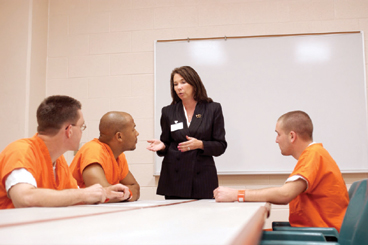
In most corrections facilities, you might see a classroom packed with offenders sitting at desks with their books open. Some might have their attention elsewhere because the course is too simple for them. Others might be lost in a sea of confusion struggling to keep up. But at the Iowa Medical and Classification Center, inmates learn in groups of two or three at a set pace so they can keep up. Rather than blending into a crowd of learners, these offenders have the chance to get their education with an abundance of attention from teachers. Iowa's GED programs also have taken a turn towards customization. According to Brenda Hampton, IMCC's education manager, tailored classes are a key to offender success. “We try to individualize our instruction as opposed to putting our students into traditional classes,” Hampton explains. “We use in-class assessments to determine where the holes are in a students' learning. We target those holes so they can have a well-rounded education at their own pace.” This month, 20 offenders graduated from the IMCC GED program, which is run by Kirkland Community College. The Kirkland GED classes typically last for two to four hours, depending on each inmate's learning pace. According to Hampton, customizing education is a philosophy long held by the Iowa DOC. “This concept actually started with a warden a long time ago. He hired a single teacher to come in and teach the inmates and for a long time that teacher worked alone. At a certain point, the state legislature realized inmates needed education and created a requirement that we offer the program. Then we got a community college involved and it just grew from there,” Hampton adds. As the GED program progressed through the years, Iowa officials and Kirkland teachers decided to offer individualized classes, and they continue to garner positive feedback from students. “I received my diploma this month through the GED program,” says offender Anthony Ray Amos. “If I wouldn't have done it here, I probably wouldn't have accomplished it. Before I went to prison, I tried to complete my GED, but I was put into a room with about 40 other people. I was very nervous about all the other people around me. I felt a lot more comfortable here and I think that made it much easier to do well.” Additionally, teachers try to ensure that students are always learning something new. “We do not want to teach these offenders things they already know. We avoid repeating things they already comprehend because it makes them more engaged with their education. We don't want to waste any time here. We focus on the student.” Inmates interested in the GED program are eligible if they don't already have a either GED or high school diploma. Offenders also take an adult basic education test to make sure they are above a sixth grade reading level. Obtaining a certificate of education helped some participants surpass language barriers. “When I first came to the DOC, I could hardly understand the English language,” recalls Andres Torres Garcia, another IMCC GED graduate. “So here, I learned the language and received my GED. The teachers here made a difference for me. If somebody gave me a book in English and told me to read it, I couldn't. But now with their help, I can read in English. My family is very proud of me.” Garcia was so moved by his educational experience that he volunteered to speak at the GED graduation ceremony. He was the first ever student speaker. Hampton says it was a moving moment. “He encouraged his peers to aggressively seek education opportunities. It was a really lovely speech, and it brought tears to my eyes. Sometimes if you hear positive feedback from a peer instead of an authority figure, it's more effective. Hearing his words made my job worthwhile,” she says. For Garcia, it was the chance to state how important the GED program was and hopefully inspire others to pursue education. “I was nervous to speak at graduation, but basically I said the things in my heart and my mind. I wanted to send a message to people. I wanted them to see how much the staff here changed my life and how when I leave prison I have a better chance at life,” he explains. Another benefit for offenders is the personable staff. According to Amos, he was initially apprehensive about trying to earn his GED. “I didn't have any confidence when it came to the GED program,” he recalls. “But it seems that a lot of times, you tend to think you are going to fail before you even start. Here, there are lots of positive attitudes in the education department. They had the attitude that I could succeed. Their time and dedication made the difference.” Bottom Line: As more GED participants receive their diplomas, Iowa officials feel confident that they are returning offenders to the community armed with education and a chance to succeed. |


advertise
|
privacy policy
|
add URL
|
about us
|
terms/disclaimer
|
contact us
|
join our team
|
help

Comments:
No comments have been posted for this article.
Login to let us know what you think