|
|
| Canines take on pruno |
| By Sarah Etter, News Reporter |
| Published: 09/25/2006 |
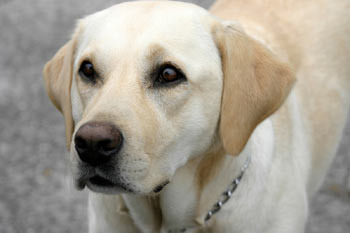 When a Labrador retriever rests his wet, black nose against your palm it usually means it's time to throw the Frisbee. But in corrections, that cute black nose can be an offender's worst enemy.
Gunner and Toby, the Los Angeles County Sheriff's Department's newest Labradors, were adopted from the local animal shelter and have been tracking down prison wine, or pruno, in jail and prison cells for the last six months as part of a trial program. Offenders typically brew pruno in five-gallon batches by saving fruit from their meals and letting it ferment for three to four days. Then they add sugar. “The more sugar an inmate uses, the stronger the wine,” explains Deputy Robert Staggs, who handles Toby and specializes in pruno detection. “We've found batches with chocolate bars floating in them. Typically, the wine is brewed in a large trash bag. Many in corrections know what pruno is, but they have no idea how easy it is to make.” Once the fermenting process is over, inmates will add heat their brew by pouring hot water over a closed bag, resulting in a beverage that has the punch of fortified wine. “To our knowledge, we're the only department in the nation working with K-9 pruno detection,” says Staggs. “We started this program because in the past several years, we've seen an increase in inmate violence. The majority of these assaults, riots and attempted suicides were a result of inmates being under the influence of alcohol. Most facilities know they have a narcotics problem, but alcohol is an issue on the rise right now.” Staggs, and partner Jon Eidem who handles Gunner, says that since the inception of the K-9 pruno detection program in February, attempted suicides in Los Angeles facilities have decreased 200 percent, while assaults have fallen 67 percent. “This program is going to change corrections,” says Eidem. “Any agency or department that deals with corrections wants to use any tool available to them that will protect personnel and the inmates in custody. This is a great tool that is proving very effective and I really believe it will curtail violence in many facilities.” Every morning, Staggs and Eidem hop into squad cars with Gunner and Toby and travel across Los Angeles counties, stopping at jails, prisons and federal facilities to let the pups work their magic. At each facility, Gunner and Toby take half-hour turns sniffing through cells detecting contraband while Staggs and Eidem keep close watch. So far, the deputies and their canine counterparts have recovered more than 70 gallons of pruno during 190 searches. “To put this into perspective, a human nose has five million odor receptors. A lab's nose has up to 250 million receptors,” Staggs explains. “These dogs don't just have the capability to sniff out a gram of cocaine; they can sniff out a half of a gram of cocaine.” Staggs and Eidem each spent five weeks in a canine training course. After learning the ins and outs of noses, scents, and best training practices, the deputies consulted a specialized dog trainer. Training a dog's nose is no easy task. Typically, a trainer will scent a rolled up towel with fumes from marijuana, cocaine or opium. Each dog then sniffs the towel before trainers hide it somewhere in a room. The dog is trained to think of each rolled up towel, and accompanying scent, as a toy. Getting these particular pups to pick up the pruno scent requires a similar process. “Within 15 or 20 minutes, the dogs really keyed in on that scent,” says Staggs. “We didn't soak the towel in alcohol. We just put one drop on the edge of the towel and let the dogs play with it. While they were playing with the towel, they were becoming programmed with the scent.” Once the pups were programmed, facility requests started pouring in. “We try to get to every facility that calls us. We really don't want to turn away a search. We just adjust our schedule the best we can. We really see these searches as just additional training and the more training we do, the more we're bonding with the dogs and the more successful the program is,” says Staggs. Eidem agrees. “The foundation of this program has really been training, for us and the dogs,” Eidem says. “That's what makes this work.” Part of that training includes making sure the dogs never fail during a search. If a dog cannot sniff out any contraband, Staggs and Eidem plant a small towel for the dogs to find. “We really make a big deal when these dogs uncover contraband,” explains Staggs. “We pet them a lot and our voices get high, and we tell them how good they are. We never want them to feel like they've done a bad job.” The dogs serve more purpose than simply pruno detectors. Both Staggs and Eidem adopted them as their own, so every night they take them home. “He's my family pet, too. He lives with me. I have teenagers and a wife and when we go home, he's just like any other pet. He's just worth a lot more money,” jokes Staggs. Staggs says the K-9 Pruno program cost the LAPSD about $67,000, not including his and Eidem's salary. Eidem thinks that's a worthwhile investment for any facility. “The feedback we've received has only been positive. If you're spending that much on a program that gets these kinds of results, I'd consider that a steal,” Eidem says. “This program will really make an impact on those administrators and supervisors who desire to make their facilities safer.” For any facilities considering a K-9 pruno detection unit, Eidem suggests finding a reputable trainer that can add alcohol to the laundry list of contraband each dog is certified to sniff out. Also, keep an eye on the local ASPCA for Labradors, whose great noses make them naturals in scent detection. And, no matter what, make sure your dog handlers are well trained and enthusiastic about the program. “This is the best assignment I've ever had,” says Eidem. “Being a part of this team is one of the best things I could have asked for. It's so great to be part of something brand new that's making a real difference.” |


advertise
|
privacy policy
|
add URL
|
about us
|
terms/disclaimer
|
contact us
|
join our team
|
help

Comments:
No comments have been posted for this article.
Login to let us know what you think