|
|
| Welcome to Camp Caisson |
| By Sgt. Larry Simmons |
| Published: 10/02/2006 |
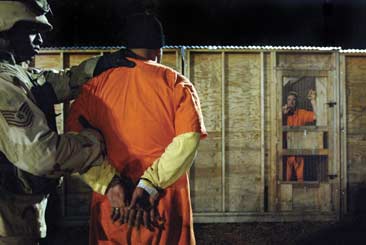 It was just another day at a detention facility in Iraq routine searches of prisoners had just begun. Twenty Airmen were searching nearly 800 detainees for dangerous items. The searches were taking a while, and detainees began shouting from the holding area. Suddenly, they rushed the unarmed Airmen and the situation turned deadly.
“You have to stay on your toes and remember your training [because] this all happened in a matter of seconds,” said Staff Sgt. Melvin Hunt from the 9th Security Forces Squadron at Beale Air Force Base, Calif. As one of the guards working that day he learned that “even after doing the same things day after day, you cannot relax even a little bit or something bad will happen.” The guards tried to diffuse the situation with the least amount of force necessary and deployed nonlethal weapons, but the detainees were still coming. The Airmen had to get away before lives were lost. They cut a hole through the fence at the back of the compound and escaped to safety. Scenarios like this are what make the Detainee Training Operations Course at Fort Lewis, Wash., so valuable. Real-world situations are used to help update training and conditions that are current with what's happening at detention centers in deployed locations. “Our training plan is constantly being updated and improved. We just sent six Soldiers to watch Airmen at Camp Bucca [Iraq] to view their tactics, techniques and procedures,” said Lt. Col. James Kearse, 3/358th Training Support Battalion commander at Ft. Lewis, Wash. “We are learning from each other.”  Army Sgt. 1st Class Troy Brown describes proper teamwork and technique for firing from behind shields. This is the common formation used when entering a dangerous situation as a riot team. With Airmen doing everything from fence line security to detainee guard force, the training has adapted to prepare them for life in a unique deployed environment. It has already helped nearly 1,500 Airmen who visited Fort Lewis before deploying. The training also builds cohesion, which is vital for Airmen who are expected to deploy together as one seamless unit the 586th Expeditionary Security Forces Squadron. “This training has been great getting our troops a chance to work with one another in an intense training environment, while having dedicated civilian role-players provides realistic conditions and increases the value, giving our Airmen the confidence they will need to do the missions they will soon face,” said Lt. Col. Donald Wingate, 586th ESFS commander who recently went through training. Civilian role-players are taught how to conduct themselves in ways detainees interact with guards. All role-players must complete a certification program before entering the training.  A Soldier tries to diffuse an escalating situation by talking with the detainee's mayor and assistant mayor, played by volunteer civilians. The mayor is a “trusted source” and main funnel of information between the guards and detainees. “We teach them how important it is for them to constantly act like detainees in country,” Colonel Kearse said. “Our focus is providing the trainees with realistic conditions they will soon face and how to control the situations for the safety of detainees and guards with the least amount of force necessary.” During the two-month course, Airmen and Soldiers are taught basic self-defense, convoy security, base defense, defense line fire, mount training, proper baton use and the effects of pepper spray. During the pepper-spray course, Airmen learn how to properly use the spray and then must navigate an obstacle course after being sprayed themselves. By using the pepper spray on Airmen, it not only provides them the understanding of how to react if they get sprayed, but it also teaches how to maintain position until help arrives, the colonel said. Additionally, it lets them understand the pain so they know to reserve it for situations that truly call for that force. “[It] felt like my face was on fire. I kept trying to open my eyes, but they wouldn't open all the way, and I had very limited vision,” said Airman 1st Class Gordon Scott from Nellis Air Force Base, Nev. “We have to keep our guard up and still function and not fall down.”  Capt. David Celeste is pepper-sprayed and then required to navigate an obstacle course and take down a hostile attacker. This exercise not only teaches the Airmen how to function while feeling the effects of the spray, but also alerts them to the amount of pain associated with being sprayed so that they reserve it for intense situations.  Army Sergeant 1st Class Troy Brown instructs Senior Airman Hayden Crawford how to properly take down a detainee, played by Army Staff Sgt. Victor Estello, during the pepper spray portion of the course. Airman Crawford is from Mountain Home Air Force Base, Idaho. At the end of the training Airmen are put in charge of a compound, replicating what they'll see while deployed. They're tested on various scenarios to see how they'll react. This exercise allows the younger Airmen to lead and make decisions, and allows the trainers to see who excels and who might need more training, said Army Capt. Joseph Sullivan, an observer controller trainer.  Airmen try to subdue a hostile detainee, played by Army Staff Sgt. Jesse Diego, so they can transport him to an interrogation. “This has definitely prepared me for going to Camp Bucca,” said Senior Airman Jason Andrada with the 99th Security Forces Squadron from Nellis. “It will help shorten the time it will take to cope with my surroundings and do my job correctly.” And adhering to their training is vital. Like so many others around the Air Force, these Airmen are adapting to a new role. They must transfer their experience from guarding aircraft and airfields, to guarding individuals who could be responsible for killing others. This course prepares them for the unexpected that comes along with this role. Editor's note: This story was previously published in “Airman Quarterly” the summer of 2006. |


advertise
|
privacy policy
|
add URL
|
about us
|
terms/disclaimer
|
contact us
|
join our team
|
help

There are a variety of factors that can lead to a car accident in Central Texas. Our accident attorneys will review your claim to examine if there is enough evidence to support a civil claim for financial compensation. You may be eligible to file a personal injury claim if you were involved in an auto accident that was caused by a negligent driver Our car accident attorney work with you to determine how this Waco car accident has changed your life and what you need to go forward. can work around the clock to address issues such as medical bills, calls from creditors, communications from insurance companies, and legal fees.