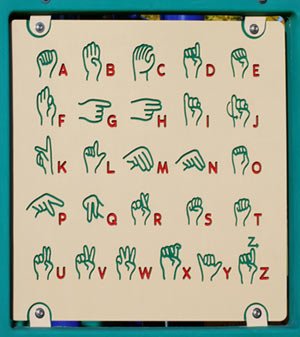
 Eileen Baker grew up the daughter of deaf parents. Now, she uses her background to communicate with deaf and hard of hearing inmates to understand their needs.
“I grew up with exposure to the communication of the deaf culture,” Baker explains. “After that, I went for a Master's Degree in Education for the Deaf and began consulting with corrections facilities.”

Living in custody can be difficult for those with hearing disabilities. Consultants like Baker visit facilities across the country to make sure each state is compliant with the Americans with Disabilities Act, which requires that all individuals with disabilities are given the same rights and access in government facilities.
Baker hopes to make a difference for these inmates by conducting interviews with deaf offenders, suggesting tips to administrators and training staff.
“When I go into a prison, I try to get a sense of the daily operations,” Baker explains. “If someone with a hearing disability is attending GRE classes, for example, I have to make sure they've been appointed an aid that can sign the classes to them.”
It is estimated that roughly 20,000 inmates across the country are deaf or hard of hearing. Baker says that due to a frequent rotation of corrections officers, some DOC employees have no idea they are dealing with a deaf inmate, which can lead to a breakdown in communication and badly managed care for deaf inmates.
“When you are deaf or hard of hearing, daily operations are completely different. If an officer is doing role call or telling you it's time for dinner, it's difficult because you cannot rely on oral communication. These offenders need to be notified in different ways. They cannot just guess what's going on because the cell doors open,” she says.
One way to accomplish this is to install small lights to signal meal times, or to house some who cannot hear so well with someone who can. Some offenders say they don't mind having a small card taped to their cell, which alerts CO's about their condition. Baker warns that officials should clear this with an inmate first since it is not a suitable solution for every offender.
DOCs also must provide sign language interpreters for those attending classes or religious services, and in some states a certified interpreter is required, which was the case in Missouri.
“We were facing a lawsuit for not providing a certified interpreter for a deaf inmate,” recalls Victoria Meyers, director of human services for the Missouri DOC . “Initially, staff members were providing inmate interpreters, but once the case went to court, it was ruled that we had to provide a certified interpreter. Consequently, that was a major issue for us.”
When the MODOC officials realized they needed to change procedures, they called Baker. She suggested a number of changes, but one of the most important recommendations started at the front door.
“She pointed out that we needed better assessment on the front-end,” says Meyers. “We had to look at what these offenders needed and what their status was. Are they totally deaf? Are they hard of hearing? Do they need a hearing aid? Do they read lips? With her recommendations, we got a great assessment up front about what these needs were.”
It is important to ensure, however, that ADA compliance process do not spiral out of control into special treatment.
“There is a fine line here,” says Baker. “Certainly, the deaf and hard of hearing have rights behind bars, but you also want to make sure they don't get privileges they shouldn't have. There are obviously limits to how far your agency has to go.”
Meyers says that after Baker's consultation, staff and administrators were on the same page when it came to offender treatment. Meyers says that sensitizing staff to the needs of deaf and hard of hearing inmates is a great way to raise understanding and promote awareness within facilities.
“We needed our staff to understand that all deaf offenders are different. They don't all use sign language, they don't all read lips. We really had to come to an understanding about the best way to manage these offenders. This is an issue that affects many corrections facilities, and these consultants are a great asset for us.”
For more information on consultations, best practices, and training sessions, email Eileen Baker.



There are a variety of factors that can lead to a car accident in Central Texas. Our accident attorneys will review your claim to examine if there is enough evidence to support a civil claim for financial compensation. You may be eligible to file a personal injury claim if you were involved in an auto accident that was caused by a negligent driver Our car accident attorney work with you to determine how this Waco car accident has changed your life and what you need to go forward. can work around the clock to address issues such as medical bills, calls from creditors, communications from insurance companies, and legal fees.