|
|
| Moose: It's what's for dinner |
| By Jim Montalto, News Editor |
| Published: 11/20/2006 |
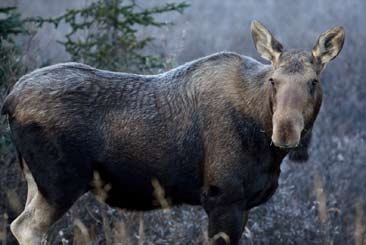 As the Alaskan winter approaches so do the snow blizzards that tie up traffic and grind everyday life to a halt. It's not long before the mighty plows push through the snow to get planes, trains and automobiles running again. The Alaskan Railroad takes little time pushing the mounds of snow off its tracks to minimize travel disruptions. However, its efforts also attract another obstacle that can practically shut down a route at a moment's notice.
The large clearings created by the plows draw moose looking to escape the deep snow in the wooded acres bordering the rail lines. This inevitably causes a standoff between train and beast, with the battle usually going to the larger, faster entity. “The locomotive alone weighs about 425,000 pounds. Add 80 to 100 railcars behind that with the entire train going 30 to 40 miles per hour around a corner, and you don't want to be suddenly breaking,” explains Alaska Railroad PIO, Tim Thompson. “It can be dark out there too and unfortunately there aren't many options for a train when it suddenly sees a 1,000 pound animal standing on the tracks.” Thompson says they do plow about ten feet on either side of the tracks to give moose and other wild animals room to gather when they avoid the forest snow. Even so, area moose will sometimes move onto the tracks, and rarely move away because they don't see a speeding train as a threat. “Sometimes, the railroad can't help but hit the moose, but it wanted to do something responsible with the meat that was salvageable, so they called the Alaska Department of Corrections to see if we could help,” says Joe Schmidt, superintendent of the Point McKenzie Correctional Farm. When an auto hits a moose, it usually involves shards of glass and metal debris, making the animal's meat unusable. However, a train's plow-like apparatus on the locomotive front, known as a cow catcher, actually pushes the moose off the tracks causing minimal damage to both animal and engine. Even though the cold weather can serve as a meat preserver, the length of time it once took the state to find an organization to pick it up the hit moose was lengthy. “In early 2005, before our work with Joe, we had an incident where a kill occurred but sat at a crossing for about three weeks, making it unsalvageable. Now we don't have that problem. Our crews know within minutes if there is a kill, and are then calling the AKDOC to let them know there's a pickup. Within an hour or two, they're there picking it up,” says Thompson. Alaska Railroad has agreed to transport kills to one of nine designated crossings along a 100-mile mostly isolated corridor between Wasilla and Talkeetna. A crew of four McKenzie prisoners and one correctional office use a winch to pull the moose onto a flatbed truck, where it is then transported to the facility.  The crew moves a moose onto a flatbed “We have a place inside the barn that's kept at about 32 degrees, where we hang the moose, much like you would do with beef or pork,” says Point McKenzie's kitchen steward Mike Gordon, who's worked on the farm for the last eleven years and helped develop its meat cutting program. “The main thing is that when it first gets here, it has to be inspected to make sure it's not seriously damaged. Then, we'll begin preparing it. It takes us about seven days to get all the meat off, and depending on the quality, some of it might go to dog mushers or the zoo.” The rest goes to Gordon's kitchen where it is ground into burgers. Part of the preparation includes adding tallow, also known as suet or fat, to help keep the lean meat moist during cooking. Gordon also cuts up the bones so they can used in soups. (He suggests moose barley or moose vegetable.) “Because moose is so lean, adding suet helps the meat stick better when making patties. It also prevents it from falling apart in the frying pan, and it gives the meat a little more flavor,” Schmidt explains. Once prepared, Gordon packs the meat and bones in big bags for the Food Bank of Alaska, which provides food and related services to 300 partner agencies in communities across the state. “Last year was the first year of the moose salvage program and we got about 1,000 pounds of meat. We'll drive out to Point McKenzie every day to pick up food, and around now, from October to January, we'll start getting the moose burgers,” says Merri Mike Adams, director of development for the Food Bank of Alaska. Since October, Alaska railroad has only been involved in one kill in the Wasilla and Talkeetna corridor, so there haven't been many moose burgers so far. Point McKenzie has this year given Adams about 63,117 pounds of food, all grown or prepared on its farm, which equal a little more than 42,000 meals that the food bank then provide to needy Alaskans. Adams estimates this food, and the food bank itself, helps one of every eight people. “Thanks to this project, a high protein and, state-favorite, food gets to all of Alaska. When these incidents occur, it is nice to know that it will be handled professionally and in then end can provide a benefit to those who need it,” adds Thompson. “Point McKenzie has been so great to us because it has helped us give senior citizens and others much needed fresh produce and food that they otherwise could not afford,” Adams says. The moose salvage program incorporates a powerful combination of people and ideas that even the harsh Alaskan winter can't stop. The railways stay clear, offenders learn new skills in food preparation, and those in need get to enjoy good, healthy food. Perhaps it is no coincidence that this beneficial program comes just in time for the holidays. |


advertise
|
privacy policy
|
add URL
|
about us
|
terms/disclaimer
|
contact us
|
join our team
|
help

Our truck accident lawyers have seen many causes of these accidents. They can often include an improper lane change, incorrect stopping distance, defective equipment, an inexperienced driver, an unqualified driver and road defects. Our team of trucking accident attorneys will investigate your accident with the help of experts to determine the most likely cause of your 18 wheeler accident. While you wait for the conclusion of your truck accident claim, your Waco 18 wheeler accident lawyer can work around the clock to address issues such as medical bills, calls from creditors, communications from insurance companies, and legal fees. Semi truck owners are required to carry more extensive insurance coverage, the trucks are subject to a strictly controlled maintenance schedule, and drivers are required to track and limit their time on the road. But many trucking companies pressure their drivers to drive without sleep to get to their destination. This creates fatigue for the truck driver.