|
|
| Becoming a prison town |
| By Ann Coppola, News Reporter |
| Published: 08/20/2007 |
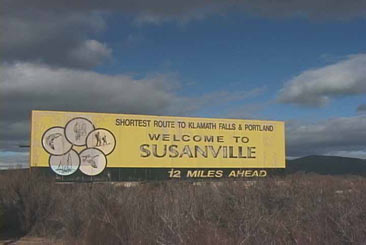 There are some U.S. towns that when mentioned get the, “oh, you mean that prison town?” response. The phenomenon of small, rural towns building prisons in order to stimulate their economy brought the prison-building boom of the 1990s to its height, when a new prison or jail opened every fifteen days. A decade later, these “prison towns” are finding that their decision to build has altered their way of life in more ways than they could have imagined.
Prison Town, USA is a new documentary that examines how the residents of Susanville, California are adapting to their prison town status. Co-directors Katie Galloway and Po Kutchins chose their topic after realizing just how far-reaching the prison town experience had become. “Both of us had done a lot of criminal justice stories and documentaries over the years,” Galloway says, “and we had gone around the country interviewing inmates for various stories when we started noticing this phenomenon of the rural prison town where the main economic engine is corrections. We thought, what about a documentary about the implications for one of these communities?” Although Galloway and Kutchins had dozens of towns to choose from, the voice of a Susanville resident ultimately convinced them that the town would be perfect for their film. “We started researching and came across an article by Joelle Fraser, who lives in Susanville, and it gave a great sense of how corrections influenced the town,” Galloway says. Fraser’s article, “An American Seduction: Portrait of a Prison Town” tells the story of how the small town turned to corrections as its savior, but instead found a multitude of undesired consequences. “Now, when I hear of other small towns campaigning for the panacea of a prison, I want to say, listen to this story first,” Fraser writes. “I think: let me tell you about Susanville.” After two mines and an army depot closed, the town was reeling and in search of economic stability. In 1992, residents voted to build the maximum security High Desert State Prison just eight miles outside Susanville’s town center. Prison Town, USA explores the stories of four individuals that illustrate the collateral damage from that decision. “We wanted to follow a local business person affected, people going to work in the prison, and the story of an inmate,” Kutchins says. “We wanted to show all the different angles of what it’s like to live in a place where everything revolves around corrections.” The film tells the stories of dairy farm owner Mike, corrections officers in-training Gabe and Dawayne, and Jennifer, the mother whose family becomes trapped in Susanville after the incarceration of her husband. “Jennifer was actually the person we followed the longest,” Galloway says. “We went to Crossroads Ministries, a place that works with struggling families connected in one way or another to the prisons. We asked if there were any people there who had loved ones incarcerated and that’s how we found Jen.” Jennifer Tyler and her family were passing through Susanville when her husband was arrested for shoplifting $40 worth of groceries and diapers. Lonnie Tyler received a 16-month prison sentence, which left Jen, her seven-year-old son Jeremy, and infant son Corey stranded in the prison town. “One in ten children has a parent in prison or on parole or probation in the US: that’s a shocking number,” Kutchins says. “When you see little Jeremy, you realize that one in ten kids are just like him. It really connects you to the emotional truth of it.” The film takes on more of a fictional drama feel than a documentary as it covers Lonnie leaving prison, and struggling to find a job and support his family while his parole keeps the family in Susanville. “To be ‘following the action’ like we do in this film, you need to find interesting people who are compelling on camera, whose stories will be unfolding in front of you,” Kutchins adds. The second compelling story was Mike O’Kelly’s, the local milkman who appeals to the city council to stop Prison Industry Authority from taking away his contract with High Desert. “We sold an awful lot of milk to that prison,” O’Kelly says in the film, “and if we lost it, it would be a huge blow to Morning Glory Dairy and be a pretty significant blow to the city of Susanville.” Mike’s story led the filmmakers to Gabe, who worked for Mike until he decided to train at the corrections academy along with his friend Dawayne. The film says that nearly half of the adults in Susanville are employed by one of the three area prisons. “What really resonated with me was seeing the hard choices people have to make,” Galloway says. “Corrections officers are drawn very stereotypically in the media, and if you don’t have a personal connection to that life, it’s difficult to see the complexity, the humanity of those people.” Gabe and Dawayne are drawn to the prison in hopes of earning higher pay and better benefits. “People think everyone who goes into the corrections line of work are big law and order types who enjoy wielding the club,” Galloway says. “Here you watch people who weren’t sure at all that working in prison was what they wanted, and you see the effects of dealing with that tension. It’s a decision based on economics; it’s not necessarily what they want to go into.” Following Gabe and Dawayne helped the filmmakers unearth the community tensions unique to a prison town like Susanville. The inmate families, CO families, and non-CO families all have difficulty interacting and understanding one another. “We spoke with the editor of the Lassen County Times, Susanville’s county paper, at the film premier,” Kutchins says. “She said her husband works at a depot in town, but she’s had very little interaction with the COs and the people who moved to town while their family members are incarcerated. The people who move in for prison work turned her and other locals off in terms of an ‘us vs. them’ mentality, but she said the film made her see the truth and complexity of what the COs’ lives are like.” Through their documentary, Kutchins and Galloway hope to help their audience understand the wide variety and large number of lives that are affected by the prison system. “We wanted to expand the dialogue,” Kutchins says. “I hope that the film will make people question whether expanding incarceration is the best way to go. Does it make sense to have 50 percent of offenders in prison for nonviolent offenses? Does it make sense to have sentence lengths five to twelve times longer than any other comparable developed country? I hope people will question whether building more prisons and jails is a solution.” “We do raise a lot of questions that need answering, but we don’t have all the answers,” Galloway adds. “We hope people are thinking about alternatives to incarceration by very punitive sentences, and we hope people think about the implications for families and children, beyond the people who are incarcerated, and what this does to families and communities.” The film will keep that dialogue going in hopes that the “oh, that prison town” reaction someday turns into one of understanding. Prison Town, USA airs nationally on PBS throughout August. Related Resources: Visit the Prison Town, USA site Read Joelle Fraser’s article Watch the trailer . |


advertise
|
privacy policy
|
add URL
|
about us
|
terms/disclaimer
|
contact us
|
join our team
|
help

I was most impressed by reading this article. Having worked for more than 10 years with corrections I received a lot of the alienation from the community as well. Working in a prison is not always what it seems. The pay is great, but the mental and emotional stress is greater. When I say greater, I mean stress can create physical problems. There was a report done some years ago, which stated correctional employees have a higher rate of divorce than any other law enforcement agency. Now that is saying a lot. Corrections employees have a relationship with other employees. In other words, they congregate amongst themselves leaving old friends out of the network. This can create a them vs. us environment. I don't believe the alienation is purpose, but who can you relate to other than another corrections employee regarding stress. One that works with corrections is more than likely consumed with his or her work. This places stress on family and friendship. When having a new prison in town most of the employees are overworked. The only good thing is the prison will boost the economy. What communities should consider is having the prison contribute to the economy more so than the employees who are just working there. Contributions to city/local government to eliminate the stress from the taxpayers, etc. Thanks for the opportunity to write my opinion.