|
|
| Out, out blind spot |
| By Ann Coppola, News Reporter |
| Published: 02/11/2008 |
 Somewhere along the way, the word “inventor” lost its cutting edge. What once implied someone imagining futuristic new ideas now brings to mind Thomas Edison hunched over his desk by light of a single burning candle. Inventing these days might seem like nothing more than a romantic notion, but all it really takes is seeing a need for change and having the guts to do something about it.
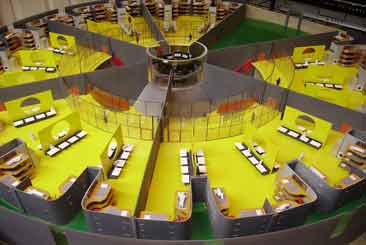
“People think that in most jails, inmates are constantly supervised, either by an officer or security camera, but that’s just not the case,” says Sonny Emerson, a modern American inventor and corrections veteran. The reason for this, he explains, are “blind spots,” or places where inmate activity can take place outside the view of a security camera or officer. Blind spots can allow suicide attempts, rapes, and other attacks to go unwitnessed and undocumented. Emerson’s new OmniView incarceration design, a jail where every movement and square inch is filmed and archived on camera, could be the first invention to eliminate these structural hideaways. “I’ve invented the only jail that has zero blind spots and constant monitoring of staff and the inmate,” Emerson says. “It is literally 100 percent. For the first time, it allows a continuous record on closed-captioned TV and DVD of what happens to the inmate from the day they arrive until the day they leave. I believe it’s the safest design ever made.” The origin of the OmniView goes back two decades, when Emerson was running Emerson House in Denver, Colorado, the first minimum security private prison in the United States. That’s when what he calls his “lifelong mission” began. “Twenty years ago I lost an inmate to suicide,” he explains. “It just crushed me. He was an 18-year old Sioux person that was about to head back to live on the reservation. In his suicide note to me he wrote, ‘I know what life is going to be like when I go back and I can’t face it.’ That just ruined me. I knew a jail with even one blind spot was not a safe jail.” To completely eliminate blind spots, Emerson started with a simple concept: a circle. Instead of a labyrinth of hallways with turns and corners you can’t see around, the OmniView is a circular jail. If you imagine yourself standing at the center of a circle and turning 360 degrees, you’d be able to see everything around you. That’s where the jail’s “100 percent surveillance” claim begins. “There is a single control room placed in the center that provides the panoramic “360 degree views” of the entire interior,” Emerson adds. “Six fixed CCTV cameras record the 100 percent surveillance and everything is permanently DVD archived.” 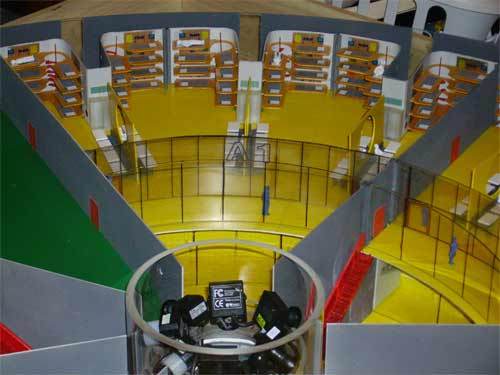 An overview of the OmniView “All of the walls facing the control center are made from commercial grade glass and are transparent,” he explains. “They get their required security level strength by being fortified by embedded stainless steel aircraft cable.” Inside the cells there are no blind spots created by furniture or other objects. The beds are vertically arranged in columns of one, two, three, or four, and face the cameras so that even an inmate attempting to hide under his bed will be filmed. The OmniView can hold up to 256 beds for a medium custody facility and 68 beds for maximum custody. The remainder of the jail’s interior is divided into multipurpose, exercise, dining, and visitation rooms. They are divided by opaque, concrete and steel walls. However, the walls are aligned to the control center in such a way that security camera views into the cells or other rooms are unobstructed. The walls are not seen by the security cameras. “With all the blind spots gone, if someone tried to commit suicide or harm themselves, what you’d have is an instant response in less than ten or twenty seconds,” Emerson says. “I think this design will make it thunderingly clear that in any other facility, people are at risk for a large number of harmful situations.” Emerson debuted the model at the American Correctional Association 2008 Winter Conference, and the presentation was a resounding success. “The working prototype performed flawlessly and was quite a show and tell, with onlookers up to five-deep sometimes,” Emerson says. “We had to borrow some Windex window cleaner to clear the fingerprints off the prototype as visitors were getting so up close and personal.” Among the interested parties were the National Institute of Corrections (NIC), the Federal Bureau of Prisons, and representatives from a Mexico construction firm. The American Jail Association has asked Emerson to bring his model to its May conference in Sacramento. Emerson says the twenty years of blueprints, models, and computer drawings will all be worthwhile if he can see his lifelong dream come true. “If the day is here when we can actually put an inmate in a facility and know in our hearts he’s not going to be raped or commit suicide,” Emerson says, “that will be a life’s work that’s worth it.” Similar to what Edison did in his time with the light bulb, Emerson hopes his OmniView will bring the dark, hidden corners of today’s prisons into the light. Photography credit: Joshua Tapia Related Resources: Watch a video explaining how the jail works See a comparison of traditional jail designs and the OmniView Read the latest PREA report |


advertise
|
privacy policy
|
add URL
|
about us
|
terms/disclaimer
|
contact us
|
join our team
|
help

Thanks for sharing the post.. parents are worlds best person in each lives of individual..they need or must succeed to sustain needs of the family. High da SEO backlinks
All your hard work is much appreciated. Nobody can stop to admire you. Lots of appreciation. dominoqq
Wow, excellent post. I'd like to draft like this too - taking time and real hard work to make a great article. This post has encouraged me to write some posts that I am going to write soon. unique domain SEO
You completed a few fine points there. I did a search on the subject and found nearly all persons will go along with with your blog. Video Camera Tower
I'm glad I found this web site, I couldn't find any knowledge on this matter prior to.Also operate a site and if you are ever interested in doing some visitor writing for me if possible feel free to let me know, im always look for people to check out my web site. du học Nhật Bản
AWFUL!! LORD HAVE MERCY! I can only agree with my previous commentor. Corrections is NOT just "monitoring" individuals 24 hours a day with the justification that they couldn't commit suicide or rape each other otherwise. Corrections is (by name) correcting criminal behavior of individuals by influencing them in positive ways, whatever that may involve. But watching every single move through a fish-tank type of institution round the clock and recording it on tape even from entry to exit (we are talking about YEARS), is certainly not corrections, that's "Big Brother" in its worst form! Maybe the "so clever inventor" of this diabolic model should go through his own system for some years and have HIS every move and fart monitored "24/7, 365 days with time and date stamp" by other people and recorded close-up on tape, including going to the bathroom and other intimate things human beings do. I would be surprised if the outcome of that experience was not subsequent confinement to a closed mental institution for the rest of his days! The company's video even cynically alledges the supposed savings by eliminating so many superflous corrections staff. Just a suggestion for an alternative: how about working with inmates to help them change and improve? Can't do this in 360° cyber-prisons with cameras and monitors, but it works without additional cost by just spending some time with and investing a little care in individuals!
Although I believe the model is of good design, the statement that response times will be within less than “ten or twenty seconds,” is the telling issue. No matter the design of the facility, it is the character, motivation, and desire of the offenders and staff persons within the facility (or any facility) that determine the safety and security of the population, staff, and visitors to the facility. The innovations within security systems, electronics, and fence construction have virtually eliminated the need for “brick and mortar,” or concrete walls in the construction of our facilities. Prisons no longer need to be multi-million or billion dollar construction projects. These funds would be better served toward staff compensation and toward institution of single cell housing in the facility. -J. Eichelberg, Indiana