|
|
| Planning for Disaster: Corrections and the Community |
| By Michelle Gaseau, Managing Editor |
| Published: 05/17/2004 |
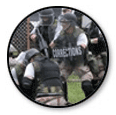
While corrections officers typically focus on emergencies inside the cellblock, they are increasingly being asked to play a different role. Corrections emergency response teams now must be ready to respond to both yard disturbances and community disasters of all types outside the prison walls. This has become even more apparent since the tragedy of 9/11. "We are always training against a planned break out or someone trying to free an inmate or a hostage situation. The skills are not that different [for a community disaster], " said Martin Horn, Commissioner of the New York City Department of Corrections and Department of Probation. "The point is, the things we train for have transferable skills and in this day and age, every government has to have a comprehensive inventory of the resources they have. Because of the resources corrections agencies have, they will be looked to." Corrections emergency response team members in New York City have increasingly become involved in preparations for disasters that might strike the city. Recently the corrections team participated in a mass disaster drill at Shea Stadium but they have also practiced responding to other scenarios including subway disasters and have received HazMat training as well. "We are unique to the extent that we have a full-time, 24/7 emergency services unit and the personnel have received NYPD (New York Police Department) and emergency services training," said Horn. Horn said that although the corrections emergency response team is not considered a first-responder unit, it is important to city officials that the members participate. "More frequently we play a back-up role. We have the manpower, extraction devices and often we are called upon to establish a perimeter security or traffic control," Horn added. That is precisely what some in the field say should be happening as governments prepare for disasters with potential terrorism links. Karl Mercer, an instructor in terrorism preparedness, believes that corrections departments need to be as prepared as any other government agency for a terrorist attack. "Everyone nowadays, whether the street officer or corrections officer, we all still have to be aware our life is never going to be the same again. In the U.S. most intelligence sources don't say if a terrorist attack will happen, but when it happens," said Mercer, who is also a former commander of the Bomb Squad for the Henrico County, Va. Preparing Corrections Mercer, who trains first responders, corrections departments and others in a course called Terrorism Behind the Walls, says there is much that can be done on a preventative level by corrections agencies to reduce threats to safety and security. In the course, which he teaches at the National Law Enforcement and Corrections Training and Technology Center in Moundsville, West Virginia, Mercer provides corrections and law enforcement officers and supervisors with information about how to recognize a potential threat. He sees jails and prisons as possible breeding grounds for terrorism that can also be central points for communication between these individuals and groups. "[In the course] I deal with the influence of international terrorism. Many jails are holding federal prisoners that could be terrorist threats or have terrorist connections. We also have a lot of background that there is terrorist recruitment inside the prisons and we still have domestic issues such as the Aryan Brotherhood and Mexican Mafia - they still carry a message inside the prison and are actively carrying out threats against people," Mercer said. During the course Mercer provides officers with ways to identify signs of terrorist or gang activity and tips about how to reduce the possibility of an incident behind the walls. By controlling the use of chemicals for cleaning, agricultural purposes and in metal work shops, for example, agencies can reduce the availability of ingredients needed to create an explosive. Mercer also shares information he has gleaned from investigating domestic terror threats by security threat groups. He said the Aryan Brotherhood, for example, makes a point of targeting Caucasian officers to establish a sympathetic ear and then bribe them to gain access to items group members may need to carry out an attack. "We do a lot of talk about the extremist and terrorist mindsets [and] the things that COs should be looking for. The prison population is a mirror of the outside population. You have the same ideologies. It is up to corrections to manage that and gather intelligence," he said. Mercer also reminds his students that domestic terrorists are just as deadly as international groups. Whether an individual's motivation is to get back at another or to make a larger statement, corrections agencies should keep an eye on these groups. "A good corrections officer should realize that terrorism can happen any place, anywhere," Mercer said. Being able to respond to these attacks is important and this is behind a relatively new training program that has been created at the NLECTTC facility in Moundsville. Mock Disaster Prepares First Responders Planned for September this year, the third annual Mock Disaster will follow a format that includes training workshops, technology exhibitions and mock scenarios for first responder units. "We are going to teach incident command and unified incident command. Any type of first responder needs to have that now," said Steve Morrison, Executive Director of NLECTTC. Past participants at the event include anyone who would be "remotely involved with a large scale incident response" including EMS, HazMat tams, the FBI, police, fire, medical examiners, health departments, search teams and others. But Morrison believes that corrections agencies should also be involved in the training, which is offered to attendees for free. "If an incident occurs and they have to evacuate a prison or if there is a chemical introduced to the HVAC system of a prison, they [the inmates] have to go somewhere," he said. Although the scenarios that agencies will participate in at the Mock Disaster have not yet been finalized for September, they will likely be as involved and complex as those of past years. Last year, for example, there were six different scenarios that took place throughout the three-day event and all were "connected" to one, large, domestic militia group. One of those scenarios was a raid on a mock methamphetamine lab that the group was using to fund its activities. Another scenario had teams storm the group's headquarters, which were complete with maps on the walls indicating the locations of local leaders who were being targeted by the group. A third incident involved the contamination of a local waterway that required dive teams to retrieve "contaminated" barrels from the river. "None of these scenarios are choreographed. We give the planners a general guideline, then we put the wrinkles in it," said Morrison, referring to "surprises" that the first responders may encounter in each incident. This year Morrison also plans to have more emergency response technologies on hand for the first responder teams to test out and consider for their own use. "Everybody in the world is coming with different things and the Department of Homeland Security has so many grants out there to develop new products," he added. Two examples of technologies that will be present this year include a less lethal water canon device that can shoot OC spray and a combination baton/OC spray device that can be hand- carried by officers. Certification for both the devices will be offered in the form of workshops at the Mock Disaster. Having experience with new technologies, combined with the actual practice the first responders receive in the Mock Disaster setting is one way agencies can prepare for a major disaster. Some states, however, are focusing on large scale Mock Disasters and table top exercises of their own. Iowa Corrections Prepares for Disaster Officials in the Iowa Department of Corrections are fully involved in the state's preparations for a potential terrorist or other major disaster - and just recently participated in a table top exercise to hammer out where emergency response can go right and where it might go wrong during such an event. "We have participated in a lot of training with public safety. Now one of the big things is the continuation of government if something happens," said Fred Scaletta, Public Information Officer for the department and the DOC's representative for homeland security training sessions. Scaletta said the state and the DOC are in the beginning processes of creating plans for keeping the government running in the event of a potential shutdown from an attack or disaster. The state's table top homeland security exercise last week reaffirmed the need for these kinds of plans. In the table top scenario, state agencies had one hour to formulate a plan for maintaining operations before their computer systems were to be attacked by a major virus. This kind of scenario could be critical to corrections as many of the agency's operations are controlled by computer systems. "The whole world operates by electronic means and computers. It starts with information we exchange with staff, our doors, our locking systems, our fences - many are computer operated. A serious virus could put us in a bad situation," said Scaletta. Scaletta said the computer virus scenario involved corrections, public safety and homeland security office representatives who had to make fast decisions about how their departments would handle the virus when it hit and maintain public safety. "One of the things that created the most discussion in the table top was if this was a real virus that affected all computers, then how can we communicate? Our telephones are going to go down, cell phones will go down, we don't have satellite to satellite communication. We have hand held radios, but they don't talk to other institutions," Scaletta said. Scaletta admits that this could be a huge issue during a disaster and one that has not been completely ironed out in the corrections department. One possible solution is for the corrections department to tie into the law enforcement radio frequencies for the state. "It is an issue we'll continue to have discussions about. We think there is a possibility that homeland security does have the capability to communicate with other agencies - but if that [type of] situation would hit all counties and all hospitals in the state [at the same time], when you get in a situation like that, then corrections won't be high on the totem pole," he said. In the coming months the computer virus scenario will be played out at a facility where emergency responders can put their plans to the test and see how they measure up in actual practice. Scaletta said these exercises between public safety organizations and corrections have picked up steam since the terrorist attacks on 9/11. "We consider corrections to be vulnerable in this whole process of terrorism and homeland security awareness -- first, because the people we supervise are candidates for being recruited and also because we are a resource to the state for assistance," he said. "Public safety is an important part of this." Clearly public safety and corrections have become closely involved when it comes to disaster planning in Iowa. In the past, as in many corrections agencies, Iowa facilities have helped with disaster relief efforts such as sandbagging, clearing trees and debris. But while these efforts are important to state officials and citizens, now assistance related to potential terrorism threats has taken a front seat. "What 9/11 has done for the DOC is put us in a situation to look at what we are doing. Are we prepared for a disaster and for terrorist activities? It has heightened our awareness to always keep an eye out for who is coming in [to our facilities]," said Scaletta. He added that since the DOC has begun to work more closely with the state's emergency management services and homeland security office, it has taken a closer look at policies and procedures related to security, changed those that needed changing and developed stronger ties with other agencies to bolster public safety. "The question is, Are you prepared? Is there something that should be done? We could be there are far as a terrorist disaster. We haven't experienced it yet and we hope we never do," Scaletta said. Other corrections agencies, such as those in New York, have also embraced this model of involvement and recognize that corrections now can play a much more public role when disaster strikes. "It's a different world since 9/11. Everyone's attitude is that we are all in this together. A lot of jurisdictions are moving in this direction," said Horn of New York City. Resources: National Law Enforcement and Corrections Technology Center - www.nlecttc.org Karl Mercer - Email kmercer203@msn.com Iowa DOC - 515-242-5707 New York City DOC - http://www.ci.nyc.ny.us/html/doc/home.html |


advertise
|
privacy policy
|
add URL
|
about us
|
terms/disclaimer
|
contact us
|
join our team
|
help

Comments:
No comments have been posted for this article.
Login to let us know what you think